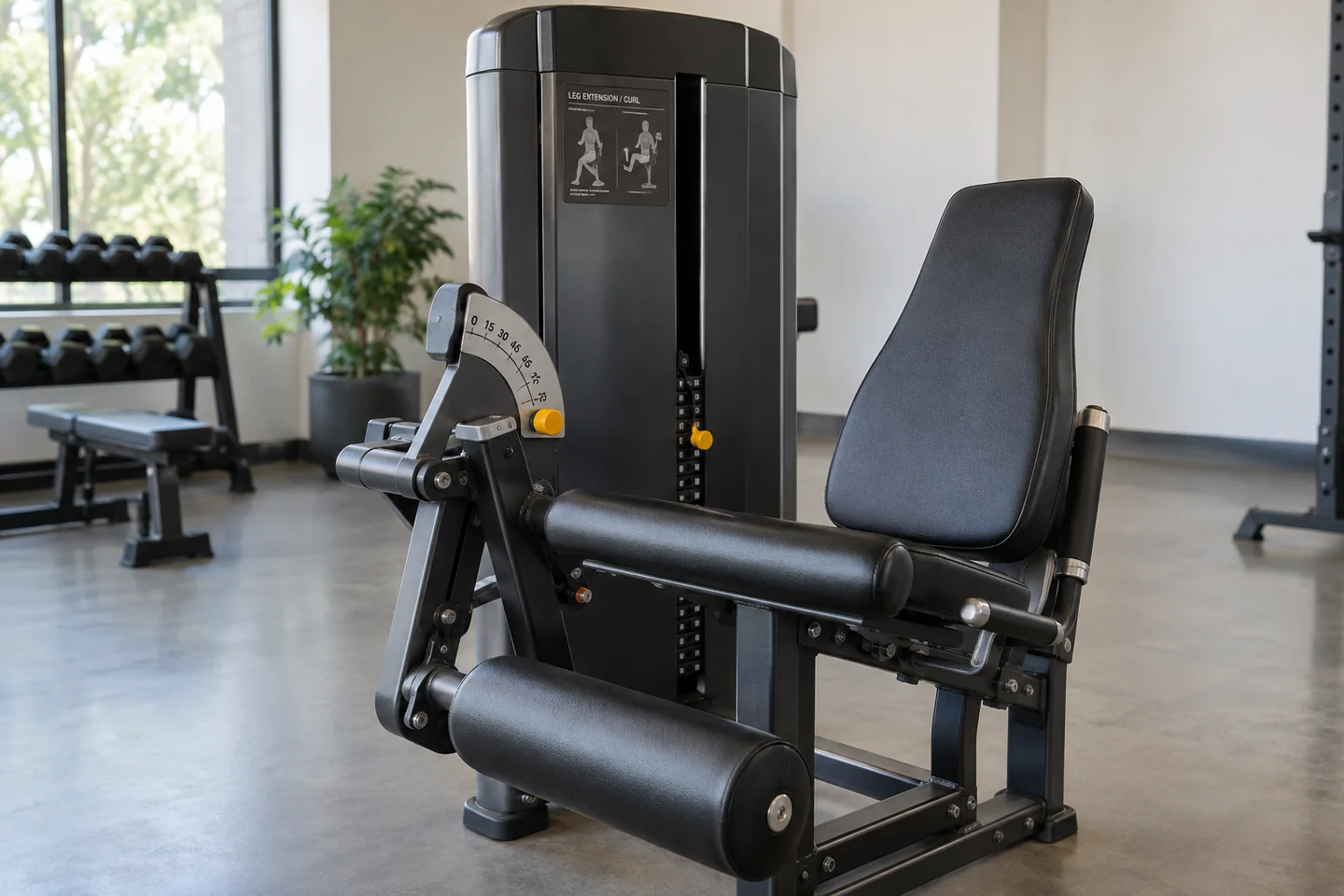
Identify the boundaries of this exercise
A machine may have a start-angle adjustment, a bench may stop the torso and a floor press may end when the upper arms meet the ground. Those are equipment boundaries. Your comfortable, controlled movement may have another boundary before you reach the machine's stop. Do not confuse the amount of travel available with the amount you must use.
Begin with an easy load or no external load, depending on the exercise. Move slowly enough to notice where control changes. Does the pelvis lift from the pad? Does the heel leave the floor? Does the torso make a sudden compensating movement? These observations do not diagnose a problem, but they show that the repetition has changed from the one you intended.
A trainer can help decide whether the answer is an adjustment, a lighter load, a different variation or a more limited range for now. If there is pain, stop rather than repeatedly probing the same point. Range should not be selected by seeing how much discomfort you can tolerate.
Make comparisons like for like
Suppose you perform a shallow squat with a heavier dumbbell and a deeper squat with a lighter one. The difference in load does not by itself tell you which session was better. The tasks differed. The same is true when one machine starts with the knees more bent or a bench press is replaced by a floor press.
Record a meaningful reference if range is part of what you are practising. That might be a box height, a machine setting or a clear description agreed with your trainer. Avoid vague claims such as 'full range' when you do not know what the phrase means for that particular exercise. A repeatable reference is easier to use than an ambitious label.
Video can help show whether repetitions are reasonably consistent, but a camera angle can also exaggerate or hide motion. Review it as a record, not as an automatic assessment. Do not turn your head to watch the screen while the load is moving.
Avoid making every repetition smaller by accident
As effort increases, a set can quietly lose travel. The first repetition reaches one position and the last barely approaches it. Sometimes a programme deliberately uses partial repetitions, but that is a specific choice. An unplanned reduction makes the repetition count less informative.
Decide on a range you can control and finish the set when you can no longer maintain the intended version. That is different from forcing a final repetition deeper with momentum. Both the depth and the ability to reverse the movement should remain recognisable.
The return direction matters too. A person may lift through a controlled range and then let the load pull them farther during the lowering phase. Watch for that mismatch on a cable or machine. Keep both halves within the movement you can manage rather than allowing the equipment to choose the endpoint.
Change range as a considered variable
If you want to explore more travel, make the trial easier elsewhere. Use a lighter load and a deliberate pace while checking the new position. Do not increase depth, resistance and speed together and then assume any difficulty proves you lack flexibility.
Sometimes equipment dimensions are the limiting factor. A handle may meet the torso, a roller may sit incorrectly or the seat may not adjust enough. Trying to force through a mechanical obstacle is not mobility practice. Ask for another setup or exercise when the machine does not fit.
Be careful with verbal shortcuts in a group class. An instruction to go lower may be intended for the group while your equipment or current control calls for another choice. Ask the instructor afterwards what reference they want you to use and explain what changes when you try it. You can describe a heel lifting, a pad losing contact or a painful point without needing anatomical vocabulary. That makes the conversation more precise than saying you cannot do the full version. A good explanation should leave you with a movement boundary you understand, rather than simply a demand to try harder.
Consider a simple equipment example: you record a leg press with the seat at one setting, then return to find the seat moved closer to the footplate. The same knee bend now begins from a different position. Before interpreting the effort, restore the intended setup. If the machine does not permit the old setting comfortably today, choose a suitable trial and note the difference instead of forcing a comparison.
A bodyweight example is a squat to a box. Replacing the box with a lower one changes the movement even without adding a dumbbell. You can learn from that change if it is intentional. If it happens because someone moved the equipment and you did not notice, the repetition count becomes a less clear record. These examples show why range belongs beside load in your description of an exercise: it tells you what the weight was moved through.
There is room for different ranges in training, but their purpose should be clear. A shorter movement can be intentional, and a longer one can be appropriate; neither earns a universal label of good or bad from its size alone. For a beginner, a comfortable range that can be repeated with control provides a clear place to start and a useful basis for future guidance.