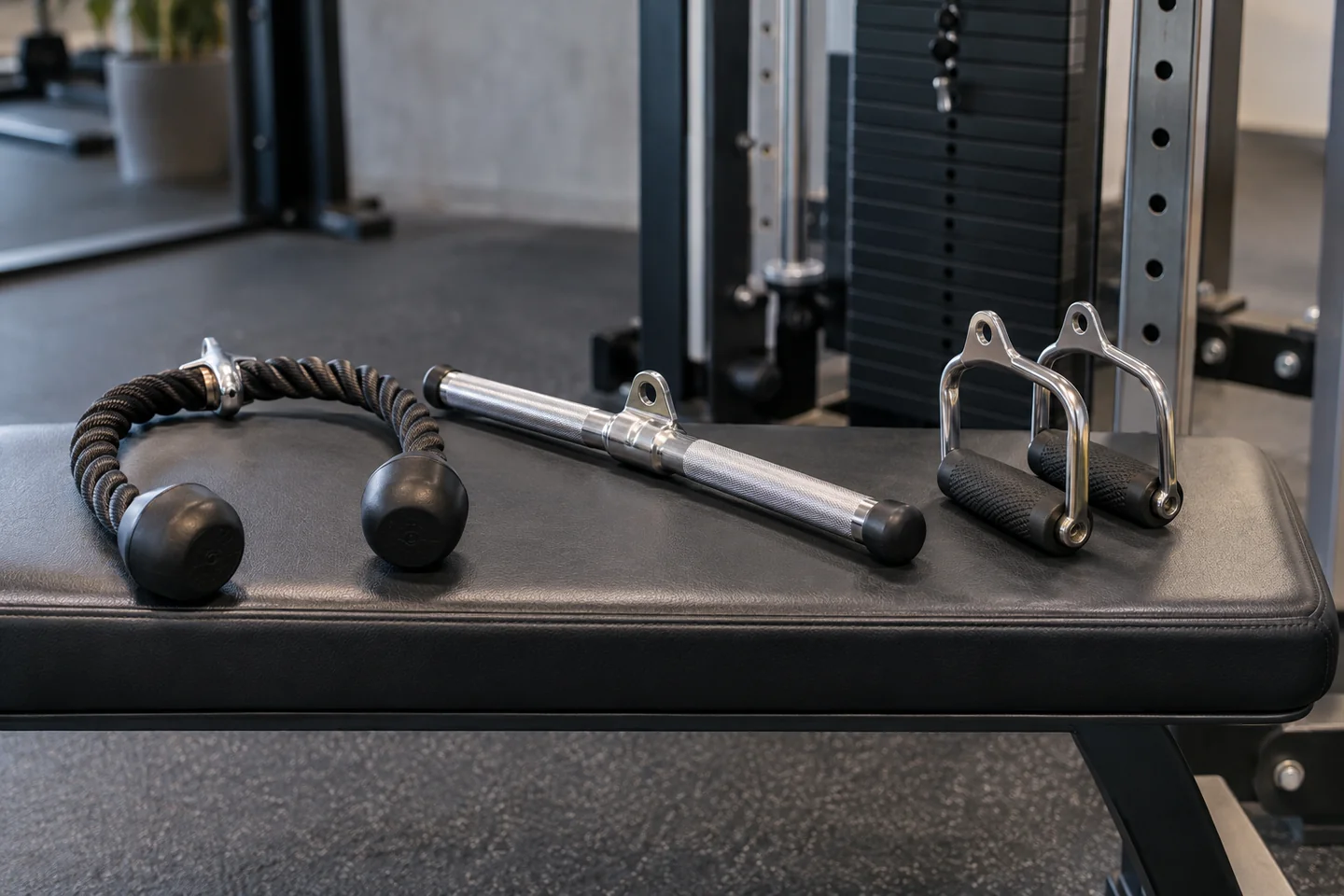
Compare the shapes in your hands
A straight bar links both hands at a fixed angle. A rope allows the hands to move more independently. A close neutral handle keeps the palms facing one another. These are visible mechanical differences; they do not mean one attachment is the best choice for every exercise or every person.
Before loading the cable, hold the attachment and check whether you can grip it comfortably. Look for worn coverings, loose end stops or damage to the connection point. Ask staff to replace questionable equipment. Make sure the approved connector closes fully when the attachment is fitted; a partially open clip is not ready to use.
Think about the entire movement
The handle has to travel somewhere. A wide bar may approach the torso differently from a compact parallel handle, while a rope may need more room at the end of the movement. Rehearse with light resistance and check that it does not strike the frame, floor or your body unexpectedly.
Do not choose a handle solely because another person uses it with a heavier stack. Their exercise, hand size and position may differ. If a grip forces an uncomfortable wrist angle, ask about another attachment or exercise setup. Changing the handle is a reasonable equipment decision, not proof that your hands need to tolerate pain.
When comparing sessions, note which attachment you used. The same stack selection with a different handle is not necessarily the same experience. Leave unused attachments in the designated storage area rather than scattered at your feet, and let the stack rest before swapping them. Taking half a minute to fit the correct handle can remove several distractions from the set: slipping hands, crowded movement and uncertainty about where to finish the pull.
If you cannot identify an attachment's intended use, ask before experimenting. Some accessories belong to a particular machine and are not interchangeable merely because the clip fits through a hole.