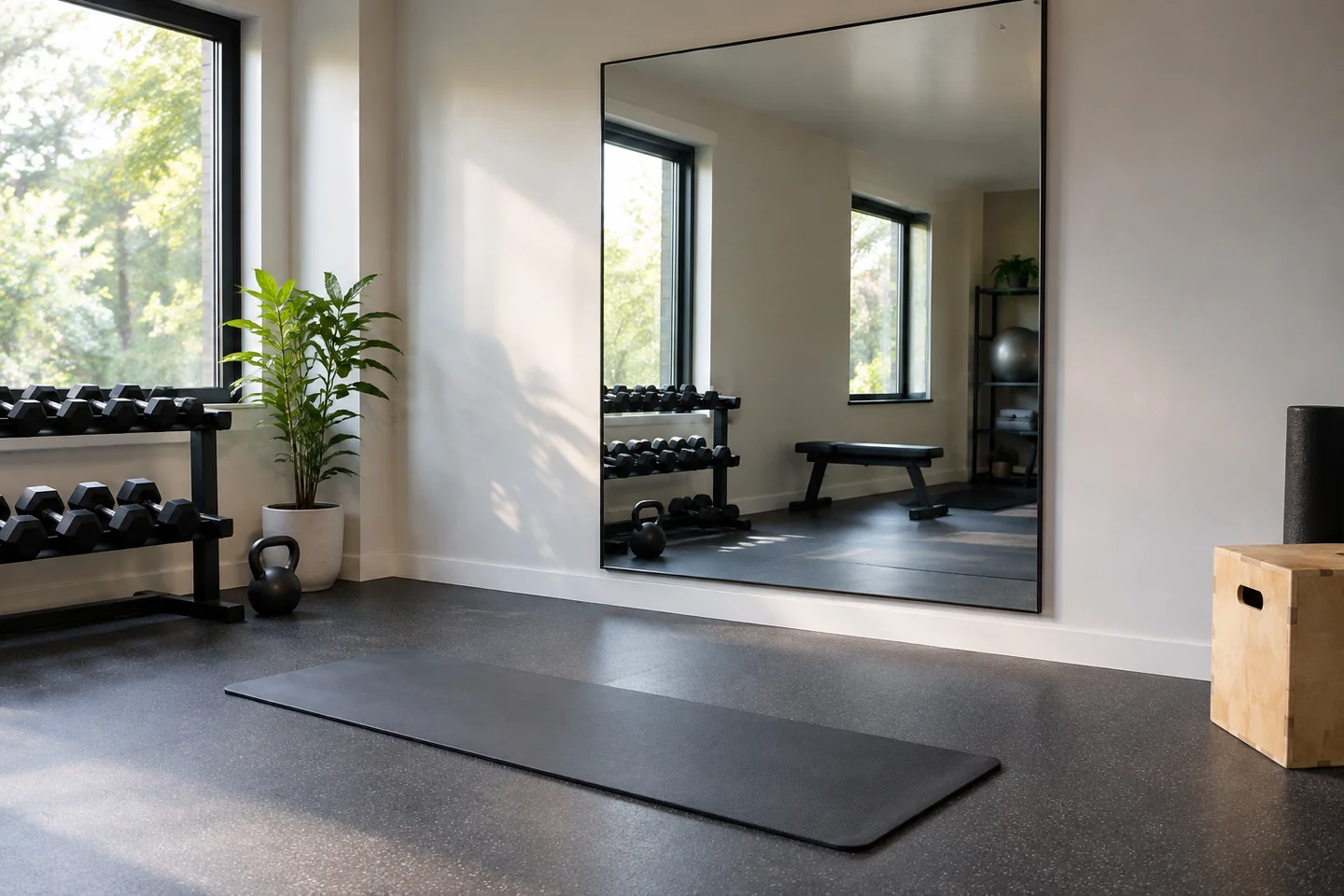
Decide what you need to see
A front view may help you notice foot placement or whether two weights are moving at very different times. It cannot show everything about a hip hinge from the side. Before moving a mirror, name the observation you want rather than assuming a full reflection provides a complete technique assessment.
Use a securely mounted mirror suitable for the room. A heavy freestanding mirror can tip if struck, and weights need clearance from the glass. Do not lean an unsecured mirror against a wall beside the moving area simply to obtain a better angle. Follow its mounting instructions and keep the exercise space away from the edges.
Check whether you can glance at the setup without craning the neck. During a row or hinge, looking directly forwards into a wall mirror may require lifting the head out of its comfortable position. It may be better to look before the set and use another form of feedback for the movement itself.
Separate checking from doing
Try a light practice repetition, stop and consider what you saw. Constantly correcting several body parts in real time can make a simple movement less coordinated. One clear observation is enough: whether the feet stay where placed, for instance, rather than trying to monitor every joint.
If the reflection makes you focus mainly on appearance, cover it or choose another position for that session. A mirror is optional equipment. You can learn exercises through instruction, sensation and feedback without watching yourself continuously.
Avoid treating a reflection as a diagnosis. Clothing, lighting and viewing angle affect what you see, and a single visible difference does not establish an injury or a weakness. Ask a qualified instructor about a specific movement question rather than attempting to correct every asymmetry you notice.
Keep the floor layout sensible
Do not move the mat closer to furniture simply to fit more of your body into the mirror. The exercise still needs its full clearance. Rehearse with no load after changing the room arrangement, including the movement into and out of position.
Lighting affects what the reflection shows. Strong light behind you can hide contact points, while a narrow mirror may cut off a foot or hand. Improve the view only if you can do so without compromising the exercise area. If seeing the relevant detail requires standing diagonally across the room or moving close to glass, use another feedback method. The mirror's limitations should not determine an awkward new stance.
A short video reviewed afterwards can sometimes answer a question a mirror cannot, provided recording is appropriate and the camera is placed safely. It has the same limits: an image is one view of a movement, not an automatic assessment. Choose the tool that lets you keep doing the exercise comfortably instead of turning the exercise into a performance for the reflection.