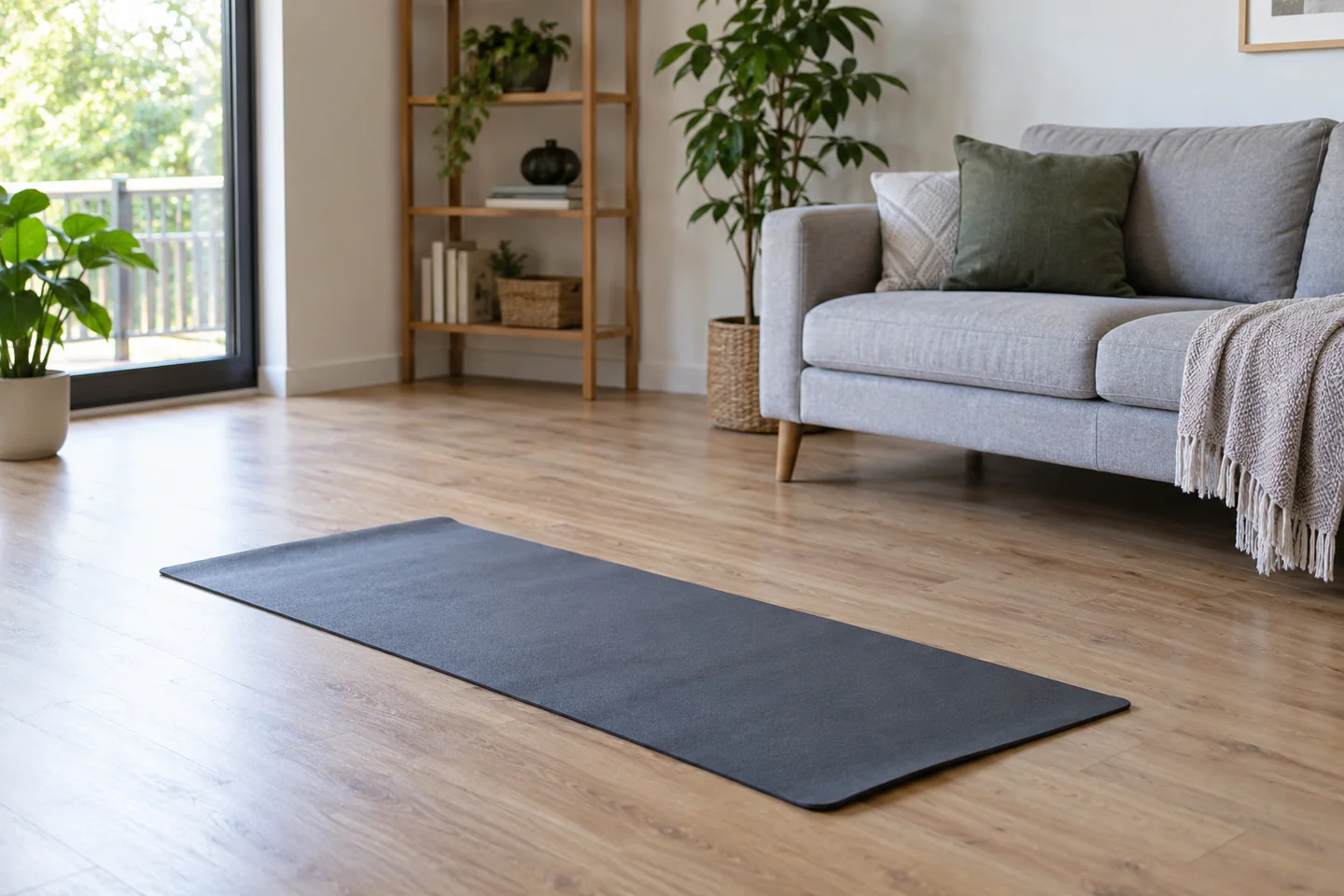
Rehearse without equipment
Put the mat where you expect to exercise, then try the intended movements without weights or bands. Reach the arms out, take any required forward or backward step and move between standing and floor positions. Notice where the hands and feet actually go. A sofa arm that seems distant while lying down may be close to a dumbbell during a press.
Check the space above you as well. Ceiling fans, lampshades and low beams matter for raised arms, even in a room with a generous floor area. Turn a fan off and keep clear of it; do not rely on judging the gap while holding weights. If the overhead space is unsuitable, choose another room or an exercise that fits.
Doors deserve their own test. Open the room door fully and see whether it crosses the exercise area. A closed door can still become an obstacle when another person enters. Agree on a clear arrangement with anyone sharing the home instead of hoping they will notice your equipment in time.
Give loose objects a real home
Move small tables, cables, toys and shoes completely out of the moving zone. Shifting them just beyond the mat may leave them exactly where a foot lands. Place a water bottle and phone somewhere reachable between exercises without keeping them underfoot. A cable running to a screen can undo an otherwise clear setup.
If weights are waiting for another exercise, put them in a stable designated spot. Round dumbbells may roll; long ones may protrude into a walkway. Keep them away from the place where you will get up from the floor, because that transition can be less precise when you are concentrating on something else.
The clear area must also include the route out. You should be able to stop, stand and leave without stepping over a band stretched across the room. An exercise arrangement that traps you behind equipment is harder to manage when you need an unexpected pause.
Make a repeatable room layout
Once the space works, note where the mat goes relative to a fixed feature such as a wall or cabinet. You do not need permanent markings, but a repeatable position reduces the amount of rearranging each time. Keep the furniture you moved in a place that does not block another household route.
Recheck after changes to the room. A new rug, a larger chair or a different lamp can affect the space even though your mat still fits in its usual rectangle. The test remains simple: rehearse the movement without resistance and include the transition in and out. That tells you far more than the floor area listed in a property plan.