Begin with the exercises, not the bundle
List the movements you intend to do and, if possible, try suitable weights with an instructor before buying. The same load may be manageable for one exercise and too demanding for another. A single pair can be useful, but it will not automatically provide an appropriate challenge for every movement in a full programme.
Avoid choosing a weight from a universal beginner chart based only on sex or body size. Experience, exercise selection and individual capacity vary. A trial with the actual movement tells you more than a label promising that one pair suits all beginners. If you cannot try the product, check dimensions, return terms and the range of available increments carefully.
Think about what the pair needs to do immediately. You may be learning a few light movements in a spare room rather than outfitting a permanent gym. Buying for a hypothetical future maximum can make today's equipment more cumbersome than necessary.
Compare the objects, not only the kilograms
Fixed dumbbells are straightforward to select and have no weight-change mechanism, but several pairs take up space. Adjustable models can provide several loads in one system, yet their size, increments and changing process differ. Some remain long at light settings; others need a tray and clearance around it. Consider how those features affect your intended movements.
Handle diameter and texture deserve attention. A handle that is secure in your hand is more useful than one that looks impressive in a product photograph. Check the length of the entire dumbbell too. Long ends can meet the thighs in a curl or make a close hold awkward, even when the weight is appropriate.
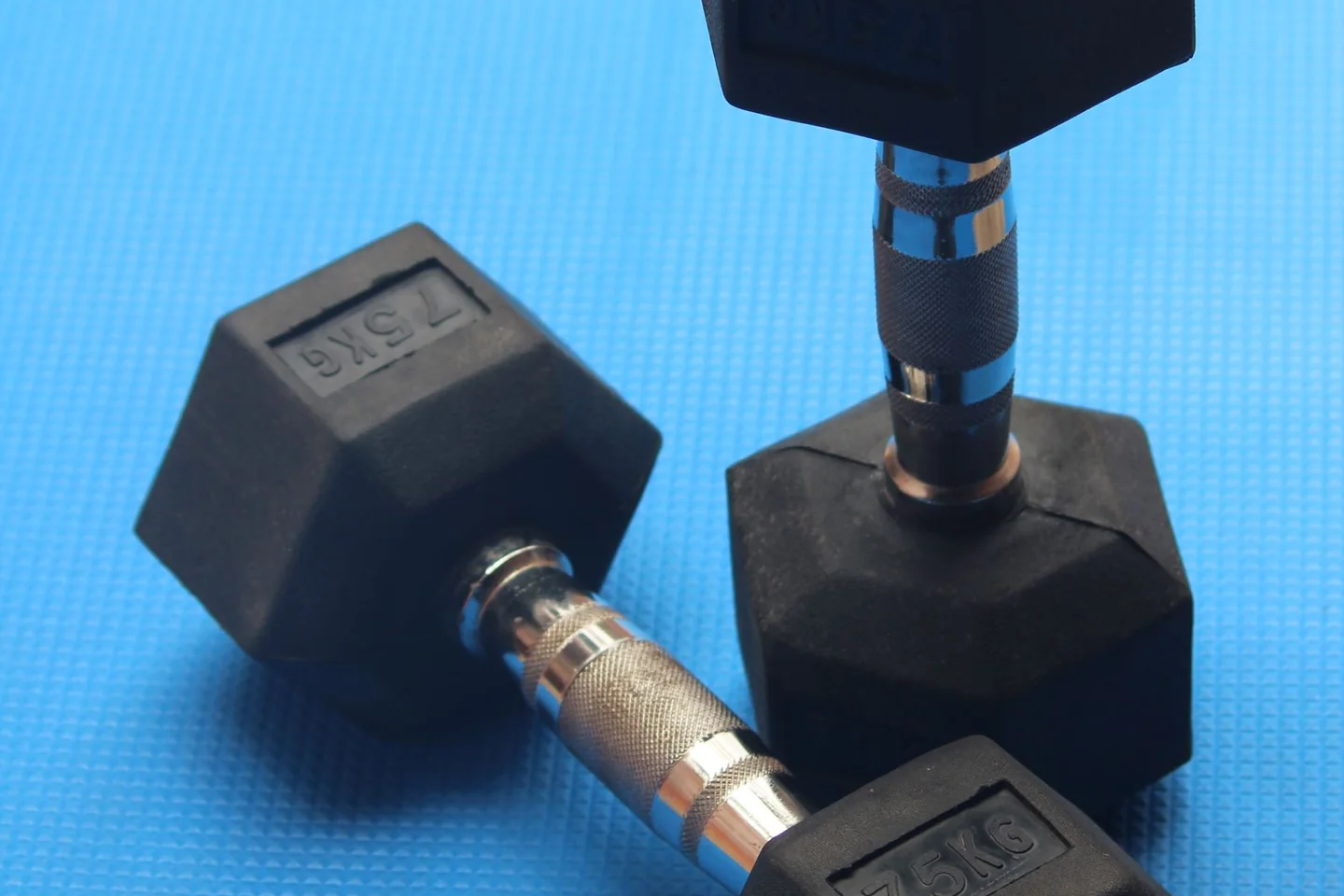
Look at the shape of the ends. Hexagonal weights tend to stay where placed on a level surface, while round ones need a storage arrangement that prevents rolling. Neither shape makes dropping equipment acceptable. Plan to set the pair down under control on a surface suitable for both the weights and the floor.
Understand what the specification includes
A listing may give the weight of one dumbbell, the pair or the whole kit. Read the description carefully. For adjustable equipment, check the minimum load and the size of each increment, not just the maximum. A large jump between settings may be inconvenient for a smaller exercise.
Read the instructions before purchase where available. Check restrictions on dropping, gripping the ends, using the dumbbells as push-up supports and storing them vertically. These rules depend on the design. Do not assume a solid fixed dumbbell and an adjustable mechanism permit the same uses.
For second-hand equipment, establish the exact model and check for current recall or safety notices from the maker and relevant consumer-safety authority. Inspect for damage and missing parts. A low price does not make an unidentified locking mechanism a sensible experiment.
Give the pair a place to live
Decide where the weights will go when you are not exercising. A low, stable storage location with suitable capacity is easier to use than a high cupboard. Keep them away from children and pets and out of the route to the door. A carrying case still needs a safe place to sit.
Measure the storage footprint, including any adjustable cradle. If the product needs room to change settings, allow for that too. Equipment that fits under a bed while unused may not be convenient to access or adjust there.
Delivery and assembly are worth considering before ordering a substantial kit. Check the total package weight and whether you can move it from the delivery point to its intended room. An upstairs location adds a handling question that a compact product photograph does not show. Arrange appropriate help rather than trying to carry a heavy box alone because it contains home equipment.
For adjustable sets, check whether replacement components and official support are available in your region. This does not require predicting every future fault; it means knowing where to find the correct information if a collar, tray or locking part is damaged. Avoid an anonymous product whose only instructions are a short marketplace caption. Clear identification is useful throughout ownership, from the first setup to checking a later safety notice.
When comparing adjustable sets, imagine an ordinary change between two exercises. Where will the dumbbells rest while you select the new weight? Can you read the markings in that position? Do you need to add plates manually, turn several controls or move a selector on each end? None of these systems is automatically wrong, but one may fit your space and patience better. A quick-change mechanism provides little convenience if its cradle must be lifted out of a cupboard for every adjustment.
For fixed pairs, check that the available lighter and heavier options use compatible dimensions and clear markings. You may only buy one pair now, but knowing the range can prevent a later mismatch. Avoid paying for a large collection solely because buying individual pairs looks less economical per kilogram. The relevant comparison is the equipment you will use, delivered and stored safely, rather than the cheapest theoretical weight of metal.
You can add to the kit later when a specific need appears. A second suitable pair, a different increment or a better storage stand can follow actual experience. The first purchase does not have to solve every future exercise. It should give you equipment you can handle, identify, store and use for the movements you have chosen now.