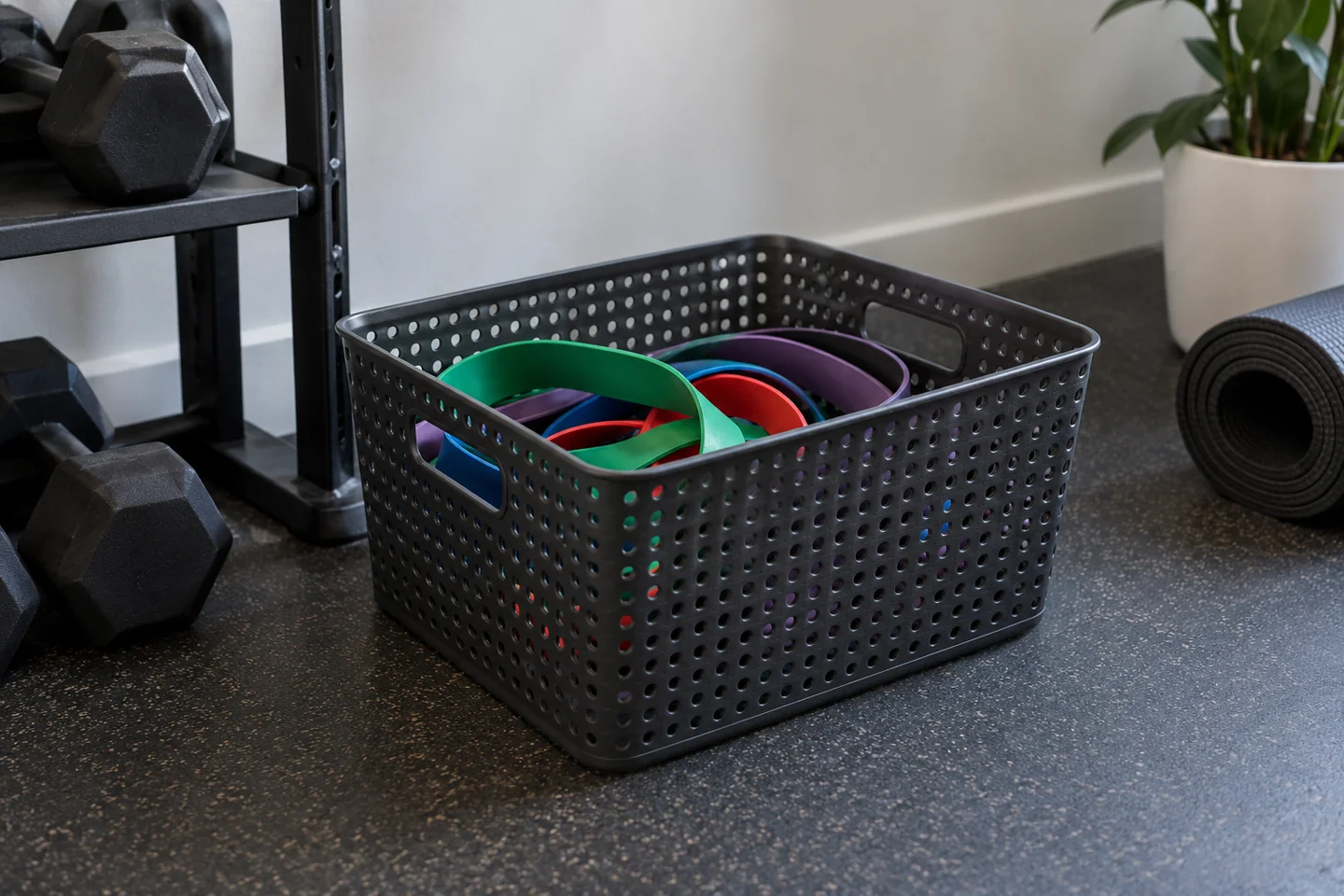
Choose a drawer for the material, not just the size
Follow the manufacturer's care directions for the band you own. Keep it away from sharp objects and avoid storing it under heavy equipment. A loose loop beside scissors, keys or a dumbbell stand can acquire damage that is difficult to notice when it remains tangled.
Many resistance products need protection from direct sunlight and extreme temperatures. A car boot or a spot against a radiator is therefore a poor default storage location. Check the specific instructions rather than assuming an elastic product can live wherever trainers and towels are kept.
Allow the band to dry as directed after cleaning before putting it into a closed pouch. Do not add an unapproved powder, oil or household treatment to change how the surface feels. Different materials have different requirements, and a product intended for one rubber item may be unsuitable for another.
Make inspection convenient
Store each band loosely enough that you can unroll it easily. Keep handles and anchors together if they belong to the same kit, but avoid compressing the band against a hard connector. A small divider or separate soft pouch can keep the pieces identifiable without turning the drawer into a knot.
Keep the product name and official instructions somewhere accessible. This is particularly helpful when several bands look similar. A note on the pouch can identify the model without marking or cutting the band itself.
Take damaged equipment out of the usable collection immediately. Leaving it in the same basket with the intention of remembering later makes accidental reuse more likely. Store replacements separately until you have checked them, then dispose of damaged items according to local guidance. The point of a storage routine is modest: the next band you pick up should be easy to identify and inspect, rather than an unknown length of elastic pulled from the bottom of a bag.