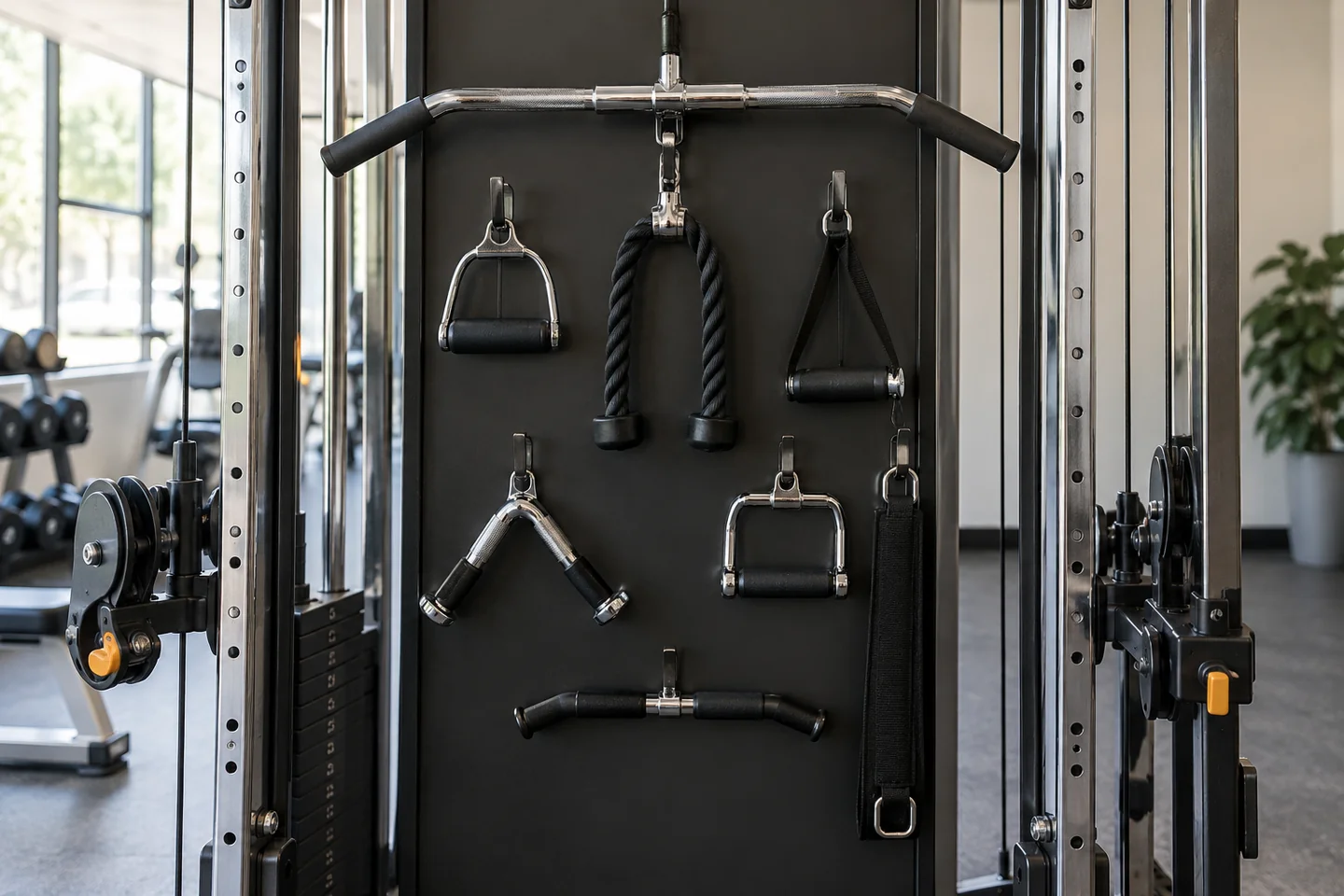
Identify the station and its intended setup
Cable machines range from a fixed single station to large frames with several independently used sections. Ask staff which part you are being introduced to and what space belongs to it. Two people may be able to use separate sides, but that does not mean every cable path can cross a shared walkway.
Begin with a specific exercise that a suitable instructor is teaching you. An attachment rack full of ropes, bars and handles is not a menu to work through without instruction. The shape of an accessory alone does not explain how it should be connected or used. Learn the complete arrangement for one task, including how to leave it afterwards.
Have the instructor identify the adjustment points: pulley position, resistance selector and attachment connection. Ask which parts should be stationary or unloaded while changes are made. There is no single set of controls that applies to every cable machine, so a demonstration on the actual model matters.
Understand the connection before touching the load
Ask how to check that the approved attachment is connected correctly. The connector should be used according to the machine and accessory instructions; do not substitute an object that merely fits through the opening. If a latch, cable or handle appears damaged, stop and tell staff rather than trying to make it hold temporarily.
Keep fingers clear of the cable route and weight stack. Do not pull at a cable while another person is adjusting the same station. If you are sharing, agree clearly who is using which part and wait until the equipment is at rest before any reset. The frame can make separate activities look more independent than they really are.
Ask staff to demonstrate how the pulley-height adjustment engages. Some designs use a pin and a sliding carriage, but the details vary. Do not let an unfamiliar assembly drop or move it while holding an attachment under tension. If you cannot see whether the adjustment has locked, ask for confirmation before use.
Read the resistance reference
The resistance display is also model-specific. Record the equipment identity if you keep notes, and do not assume that a number on one cable station feels the same on another. Different arrangements can change how a selected load is experienced. The printed setting is a reference for that machine, not a universal comparison.
A double-ended station can be particularly confusing because there may be two selectors, two height adjustments and several possible attachment points. Ask the instructor to identify which controls belong to the setup being taught. If the exercise uses only one side, do not adjust the other side as part of tidying unless the gym has instructed you to do so. Another person may be using it independently.
Make room for the whole movement
Before starting the taught exercise, check the space it requires. A handle can travel farther than the outline of the frame suggests. Keep the route away from other members, loose plates, benches and your own bag. If the available space does not suit the exercise, ask for another arrangement rather than moving into a walkway.
Put personal belongings in the facility's designated storage, not on the stack or adjustment carriage. A phone resting on a convenient flat surface can become an obstruction when that part moves. Similarly, unused handles should be stored rather than scattered near the feet of the person using the station.
If another member needs to pass, finish or pause through the procedure you have been taught and communicate clearly. Do not make sudden changes to avoid someone while continuing the movement. A busy room may require choosing a different time or a different approved station; it does not justify compressing the setup into unsuitable space.
Leave a setup that can be understood
Learn how to return the handle and settle the equipment under control at the end. Do not let an attachment pull back abruptly. Once the machine is at rest, follow the gym's process for removing or storing the accessory and leaving adjustments. Staff can explain whether the station has a standard resting arrangement.
Return accessories to their labelled place. A small handle left on the floor is easy to miss, and an attachment stored on the wrong station can make the next person's setup confusing. Clean the contact surfaces as directed and clear the surrounding area.
For your next visit, keep a concise note of the machine, attachment and adjustments you were taught. If one component is missing, ask rather than improvising a substitution. Familiarity grows from repeating a correctly understood arrangement. Once that is settled, an instructor can introduce another use without every part of the station becoming new at once.