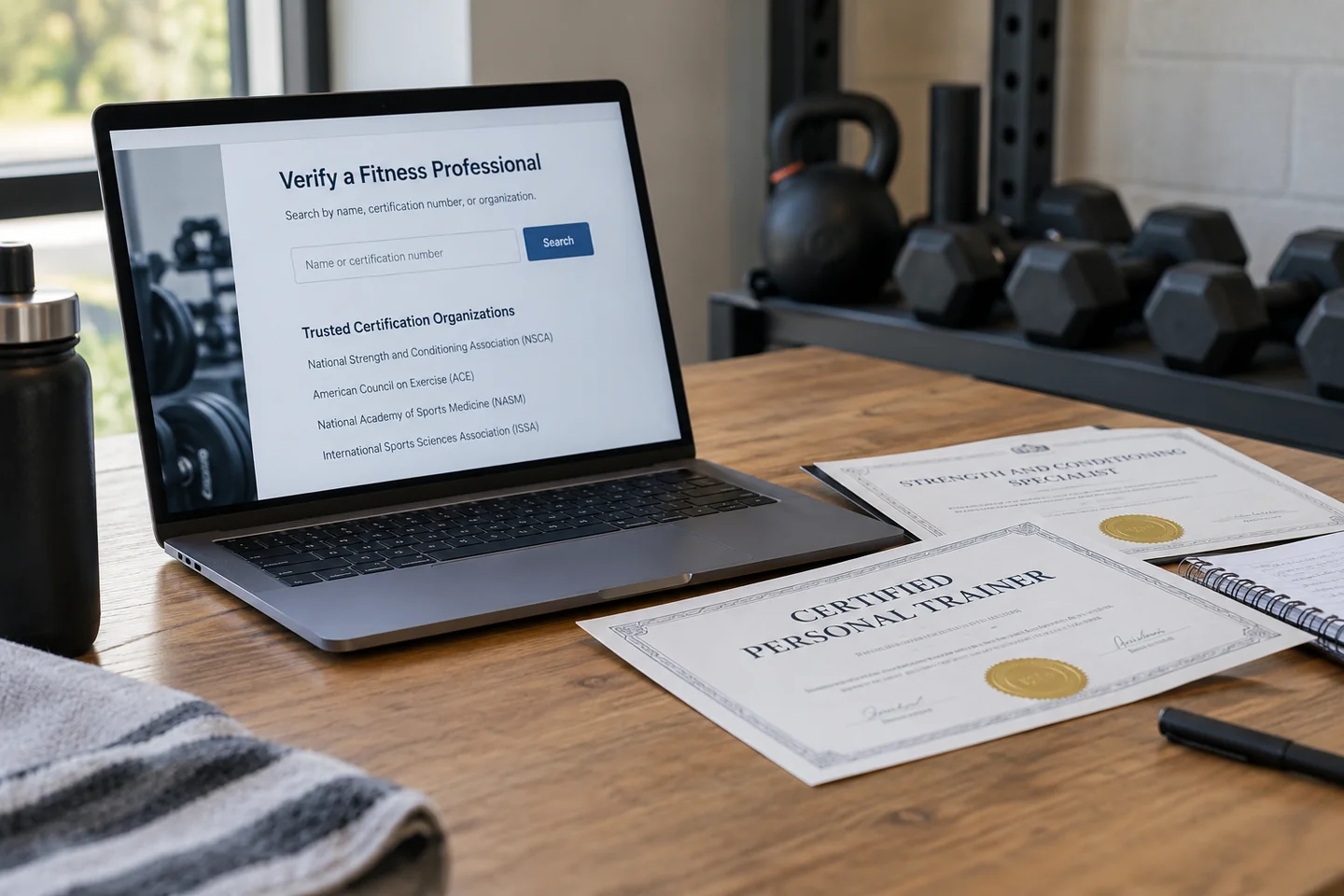
Start with the exact claim
The word 'qualified' does not tell you which qualification a trainer holds. Ask for its full name, issuing organisation and current status where renewal applies. A professional biography may combine a personal training credential, short courses and interests in one paragraph. Separating them makes the information easier to check without needing to become an expert in every training system.
Use the issuer's own verification route where one is available. ACE, for example, provides digital credentials, while CIMSPA's member directory identifies professional categories among its members. These are examples of checks within particular systems, not proof that every trainer everywhere must appear in both. Confirm the relevant organisation rather than searching a random directory that happens to rank highly online.
Match the person's name and the credential claimed. If a name has changed or a record is difficult to locate, ask for clarification and contact the issuer through its official channel if needed. An unsuccessful first search is a question to resolve, not automatically evidence of dishonesty. Equally, a screenshot alone may not settle whether a credential remains current.
Be careful with similar organisation names. Follow the official issuer's address rather than a link whose branding merely resembles it. You need not enter payment details to inspect a publicly shared credential. If the verification route is unclear, use the issuer's published contact information and ask what details are required to confirm the claim.
Distinguish a course from the work you need
Ask what a qualification covers and whether it relates to the service being offered. A short course on one subject is not the same as a broader professional qualification. Someone may accurately describe both, but the distinction matters if you are relying on the training for a specific kind of support.
Do not treat a long list of initials as a substitute for an explanation. Ask the trainer which part of their background is relevant to your request. For a beginner seeking equipment instruction, experience teaching unfamiliar gym users may be more directly informative than a catalogue of unrelated sporting achievements.
Where a medical or specialist service is claimed, check the appropriate professional credentials for that service rather than assuming personal training credentials cover it. Requirements and protected titles vary by jurisdiction. Use the relevant official body to resolve the question; the trainer's social media popularity is not a verification method.
Ask about experience without requesting private stories
You can ask how the trainer approaches clients with goals like yours, what an introductory session involves and how they decide when to refer a question elsewhere. They should be able to explain their process without disclosing another client's personal information. A respectful description of the work is more useful than a dramatic transformation anecdote.
If testimonials or photographs are offered, remember what they can and cannot establish. They may describe one person's experience, but they do not verify a qualification or promise the same result for you. You can appreciate a positive review while still checking the underlying service and terms.
Continuing development needs context
Ask about continuing development relevant to the work, but avoid assuming that the newest course automatically improves every aspect of teaching. The useful question is how the trainer applies and updates their knowledge. A concrete answer about instruction or referral is easier to assess than a claim to know the latest method.
Put the checks beside the working relationship
Credentials are one part of choosing a professional. You also need clear communication, an appropriate service and an arrangement you can attend. A verified qualification does not tell you whether a particular teaching style suits you. Use a consultation or trial, where available, to examine that part separately.
Ask about insurance and the provider's complaints process if those details are relevant to the arrangement. Find out who is responsible when a trainer works inside a gym but contracts with clients independently. Avoid assuming the building's branding makes every service part of the same organisation.
Keep the verified information and written offer with your booking records. You do not need a large investigative file; the aim is to know who is providing the service, what they are qualified to offer and what you are buying. If a basic claim cannot be explained or checked, pause the purchase until it can.
A trainer who welcomes reasonable questions makes this process easier. You can be polite and specific without apologising for wanting clarity. The check is about matching evidence to a claim, not finding the most impressive biography or persuading yourself that one credential guarantees every aspect of a future coaching relationship.